
The Genetic Programming Tutorial Notebook
Genetic programming is a branch of genetic algorithms.
The main difference between genetic programming and genetic algorithms is
the representation of the solution. Genetic programming creates computer
programs in the lisp or scheme computer languages as the solution. Genetic
algorithms create a string of numbers that represent the solution. Genetic
programming, uses four steps to solve problems:
1) Generate an initial population of random compositions of the functions and
terminals of the problem (computer programs).
2) Execute each program in the population and assign it a fitness value according
to how well it solves the problem.
3) Create a new population of computer programs.
i) Copy the best existing programs
ii) Create new computer programs by mutation.
iii) Create new computer programs by crossover(sexual
reproduction).
4) The best computer program that appeared in any generation, the best-so-far
solution, is designated as the result of genetic programming [Koza 1992].
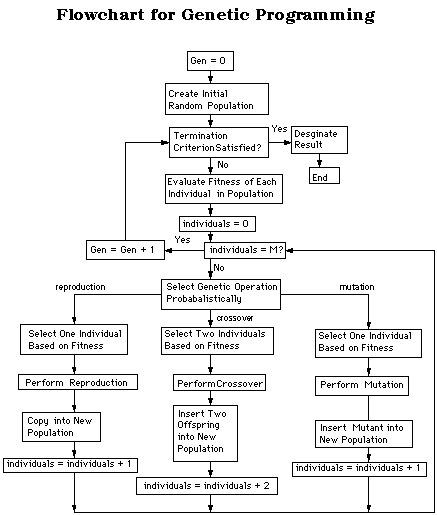
Figure 1: genetic programming Flowchart.
Fitness Function
The most difficult and most important concept of genetic programming
is the fitness function. The fitness function determines how well a program
is able to solve the problem. It varies greatly from one type of program
to the next. For example, if one were to create a genetic program to set
the time of a clock, the fitness function would simply be the amount of
time that the clock is wrong. Unfortunately, few problems have such an
easy fitness function; most cases require a slight modification of the
problem in order to find the fitness.
Gun Firing Program
A more complicated example consists of training a genetic program to
fire a gun to hit a moving target. The fitness function is the distance
that the bullet is off from the target. The program has to learn to take
into account a number of variables, such as wind velocity, type of gun
used, distance to the target, height of the target, velocity and acceleration
of the target. This problem represents the type of problem for which genetic
programs are best. It is a simple fitness function with a large number
of variables.
Water Sprinkler System
Consider a program to control the flow of water through a system of
water sprinklers. The fitness function is the correct amount of water evenly
distributed over the surface. Unfortunately, there is no one variable encompassing
this measurement. Thus, the problem must be modified to find a numerical
fitness. One possible solution is placing water-collecting measuring devices
at certain intervals on the surface. The fitness could then be the standard
deviation in water level from all the measuring devices. Another possible
fitness measure could be the difference between the lowest measured water
level and the ideal amount of water; however, this number would not account
in any way the water marks at other measuring devices, which may not be
at the ideal mark.
Maze Solving Program
If one were to create a program to find the solution to a maze, first,
the program would have to be trained with several known mazes. The ideal
solution from the start to finish of the maze would be described by a path
of dots. The fitness in this case would be the number of dots the program
is able to find. In order to prevent the program from wandering around
the maze too long, a time limit is implemented along with the fitness function.
Functions and Terminals
The terminal and function sets are also important components of genetic
programming. The terminal and function sets are the alphabet of the programs
to be made. The terminal set consists of the variables and constants of
the programs. In the maze example, the terminal set would contain three
commands: forward, right and left. The function set consists of the functions
of the program. In the maze example the function set would contain: If
"dot" then do x else do y. In the gun firing program is the terminal
set would be composed of the different variables of the problem. Some of
these variables could be the velocities and accelerations of the gun, the
bullet and target. The functions are several mathematical functions, such
as addition, subtraction, division, multiplication and other more complex
functions.
Crossover Operation
Two primary operations exist for modifying structures in genetic programming.
The most important one is the crossover operation. In the crossover operation,
two solutions are sexually combined to form two new solutions or offspring.
The parents are chosen from the population by a function of the fitness
of the solutions. Three methods exist for selecting the solutions for the
crossover operation.
The first method uses probability based on the fitness of the solution.
If  is the fitness of the solution Si and

- is the total sum of all the members of the population, then the probability
that the solution Si will be copied to the next generation is [Koza 1992]:

Another method for selecting the solution to be copied is tournament selection.
Typically the genetic program chooses two solutions random. The solution with
the higher fitness will win. This method simulates biological mating patterns
in which, two members of the same sex compete to mate with a third one of
a different sex. Finally, the third method is done by rank. In rank selection,
selection is based on the rank, (not the numerical value) of the fitness values
of the solutions of the population [Koza 1992].
The creation of the offsprings from the crossover operation is accomplish
by deleting the crossover fragment of the first parent and then inserting
the crossover fragment of the second parent. The second offspring is produced
in a symmetric manner. For example consider the two S-expressions in Figure
2, written in a modified scheme programming language and represented in
a tree.
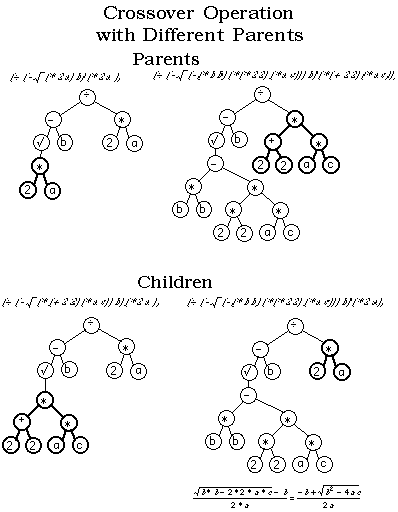
Figure 2: Crossover operation for genetic programming.
The bold selections on both parents are swapped to create the offspring
or children. (The child on the right is the parse tree representation for
the quadratic equation.)
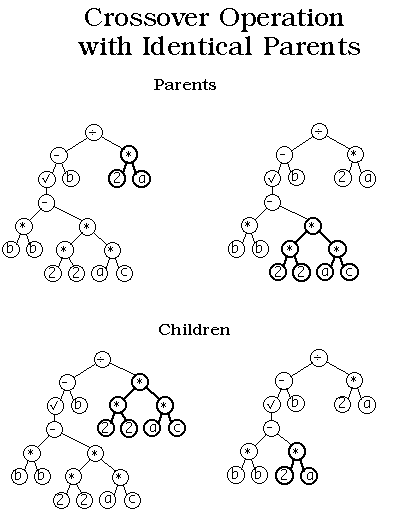
Figure 3: This figure illustrates one
of the main advantages of genetic programming
over genetic algorithms. In genetic programming identical
parents can yield different offspring, while in
genetic algorithms identical parents would yield identical
offspring. The bold selections indicate the subtrees
to be swapped.
An important improvement that genetic programming displays over genetic
algorithms is its ability to create two new solutions from the same solution.
In the Figure 3 the same parent is used twice to create two new children.
Mutation
Mutation is another important feature of genetic programming. Two types
of mutations are possible. In the first kind a function can only replace
a function or a terminal can only replace a terminal. In the second kind
an entire subtree can replace another subtree. Figure 4 explains the concept
of mutation:
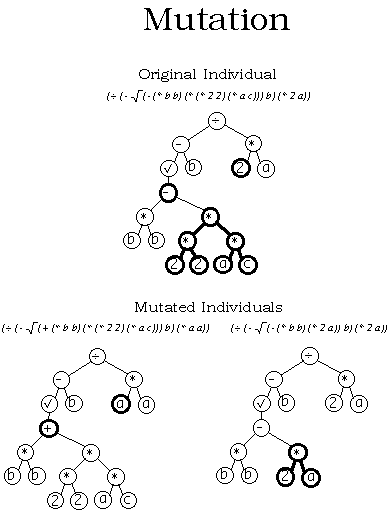
Figure 4: Two different types of mutations. The top parse
tree is the original agent. The bottom left parse tree illustrates a mutation
of a single terminal (2) for another single terminal (a). It also illustrates
a mutation of a single function (-) for another single function (+). The
parse tree on the bottom right illustrates a the replacement of a subtree
by another subtree.
Summary
Genetic programming is much more powerful than genetic algorithms. The
output of the genetic algorithm is a quantity, while the output of the
genetic programming is a another computer program. In essence, this is
the beginning of computer programs that program themselves.
Genetic programming works best for several types of problems. The first
type is where there is no ideal solution, (for example, a program that
drives a car). There is no one solution to driving a car. Some solutions
drive safely at the expense of time, while others drive fast at a high
safety risk. Therefore, driving a car consists of making compromises of
speed versus safety, as well as many other variables. In this case genetic
programming will find a solution that attempts to compromise and be the
most efficient solution from a large list of variables.
Furthermore, genetic programming is useful in finding solutions where the
variables are constantly changing. In the previous car example, the program
will find one solution for a smooth concrete highway, while it will find
a totally different solution for a rough unpaved road.
REFERENCES
Koza, John R. 1992. Genetic Programming: On the Programming of
Computers by Means of Natural Selection. Cambridge, MA: The MIT Press.
Cramer, Nichael Lynn: "A Representation for the Adaptive Generation
of Simple Sequential Programs", Proceedings, International Conference
on Genetic Algorithms and their Applications, July 1985 [CMU], pp183-187.
 The GP Notebook
- Please send all email regarding these web pages to:
 Jaime J.
Fernandez <jjf@geneticprogramming.com>
Jaime J.
Fernandez <jjf@geneticprogramming.com>
-
- Tom Lenaerts <tlenaert@vub.ac.be>
This page and all contents are
Copyright © 1996, 1997, 1998, 1999 Jaime Fernandez
Houston Texas, USA
Last Modified: May 12 1999